These built-in entertainment centers run from a simple plywood cubby system you paint in place to a full wall of millwork with recessed LED strips and vertical wood slats hiding the cords.
What separates one choice from another is how much of your gear you actually want to see when the TV is off.
The battery-powered LED strips that work for renters become a chore to maintain, while the electric fireplace under the TV needs its own dedicated circuit before you fall for the look.
1. Drawers and Cabinets for Hidden Storage
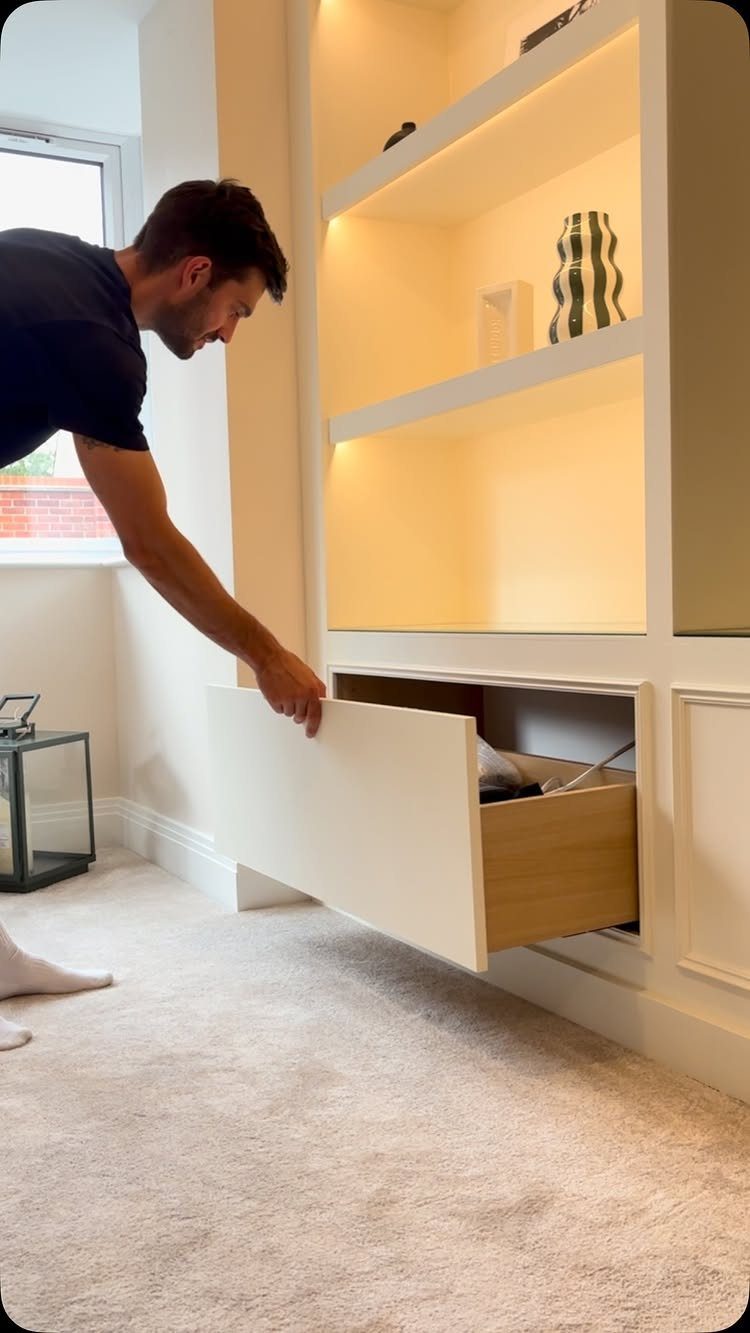
Hidden storage keeps a room from feeling like an electronics warehouse. Drawers at the base of a unit swallow remotes, spare cables, and the gaming controllers you trip over after dark.
Handleless fronts, the kind you push to pop open, keep the face clean but cost more in hardware than a standard pull.
A cabinet shop can build these to any depth; start by deciding what you actually need to hide versus what you reach for daily. I would put daily-use items on open shelves above and banish the rest below.
If your carpet is thick, check that drawer clearance at the bottom; a too-tight fit scrapes every time.
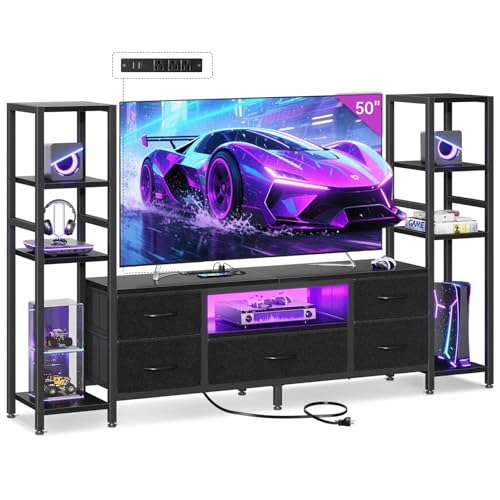
Designed for Small Spaces: This 71-inch TV stand is ideal for 43''–50” TVs and supports up to 55” with a snug, edge-to-edge fit. Designed for apartments and compact living rooms, its low-profile height keeps your space open without bulky cabinets. Tip: Please measure your TV base width for best fit.

2. Shelves with Integrated LED Lighting
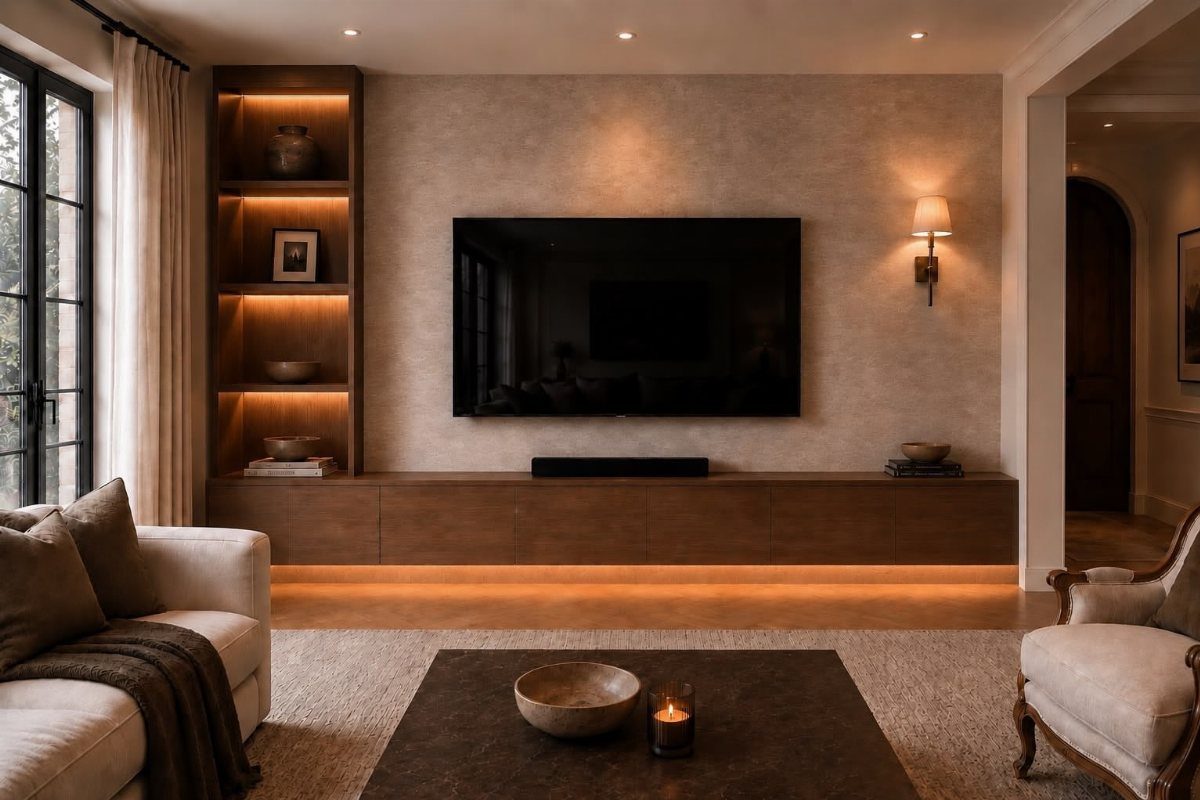
Warm light on wood shelves turns a storage wall into something you want to look at after the TV is off.
The strips sit recessed into the underside of each shelf, aimed back at the wall so objects glow rather than getting blasted head-on.
Adjustable shelf pins let you move the light with the shelf, but only if you plan for it; fixed shelves hide their wiring in walls and look cleaner.
Running new power to a cabinet bank is the step that trips most people. Battery-powered LED strips work for a rental, though the batteries become a chore.

Multifunctional Design: This floating TV stand serves as both a media center for your living room or bedroom, enhancing your viewing experience, and a storage unit. The cleverly designed drawers on both sides offer privacy while providing ample storage space for your room

LED TV Stand with Ambient Lighting: The TV stand comes with blue LED strip lights, creating a beautiful atmosphere to your living room. ROHS certification are listed to provide you with a safe and healthy living environment

[Floating TV Stand with Lights] - The floating media console can accommodate TVs up to 70 inches. It features 3-color LED lights, the remote control allows you to change lights color without effort. NOTE: This wall-mounted TV stand only workable for hard wall like cement and brick wall
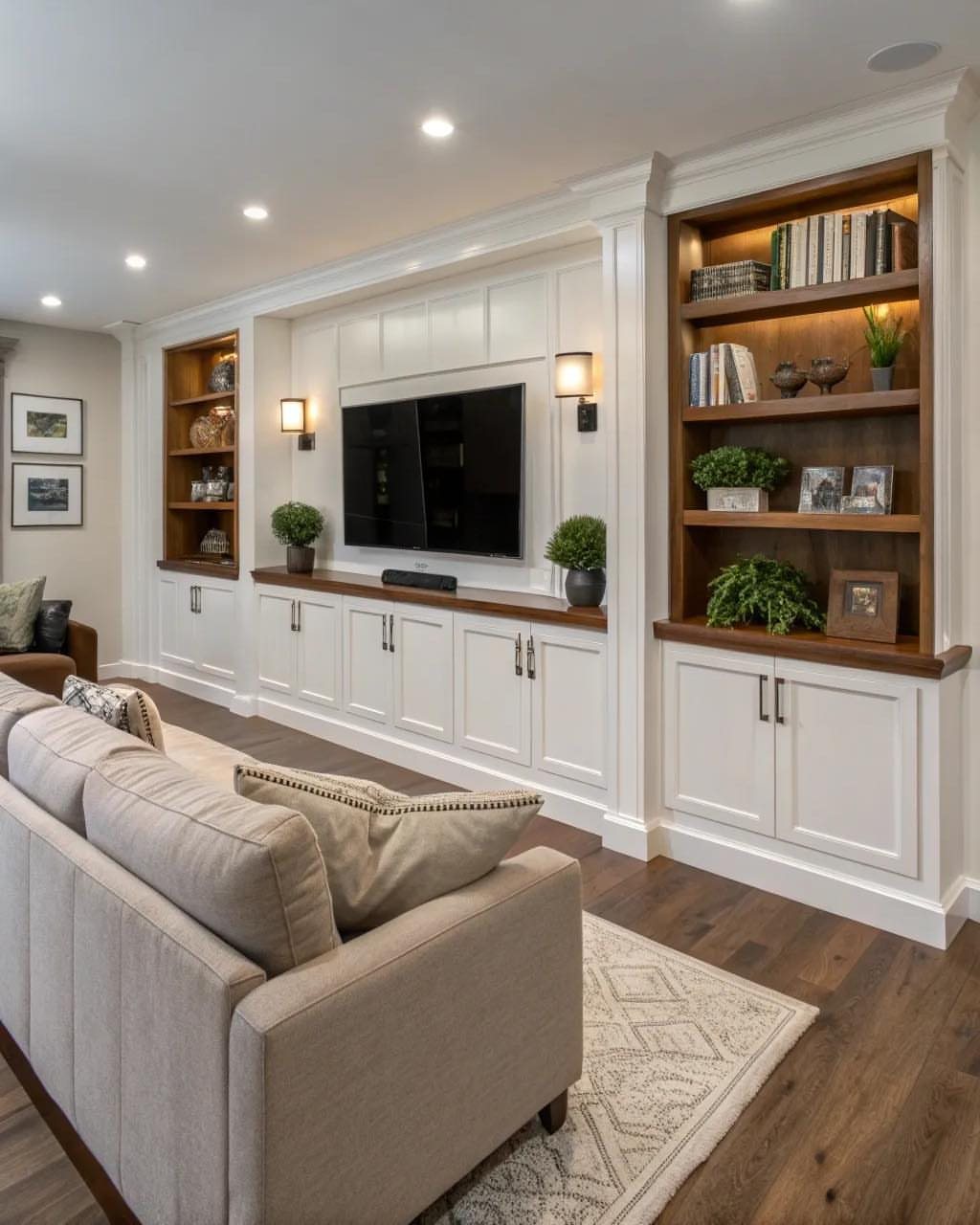
3. Floor-to-Ceiling Built in Entertainment Center
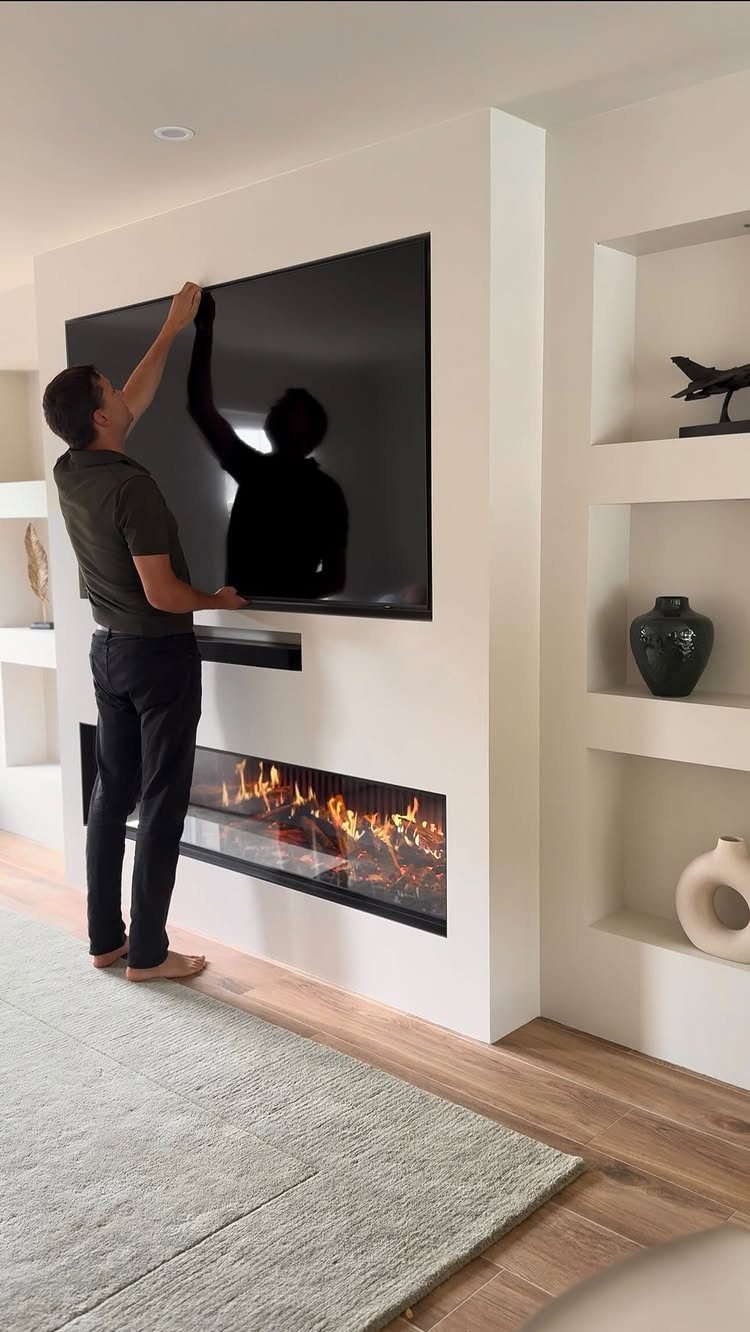
A unit that hits the ceiling commands the room whether you planned it that way or not.
Recesses flanking the screen are where personality lives, in a plant that tolerates low light or a piece you do not mind staring at sideways.
This scale eats wall space permanently. Before committing, measure your sofa distance against the screen size; a wall that runs too wide can dwarf your TV and leave you tilting your neck.
White built-ins with a linear fireplace below give one look, but the same bones work in stained wood if your trim already runs dark.
By the way, 90" on each side means the front will span an even greater distance.After you do the math it might be over 96", standard ply sheet size.

【6-Roll 12V Black PCB LED Strip in Parallel】: 6-in-1 COB LED strips installed in parallel, controlled by a single sensor. Black PCB board with 320 LEDs/M, featuring efficient heat dissipation, high flexibility, uniform light distribution, enhanced luminous efficacy, and exceptional color rendering index (CRI>90). Eliminates dark spots entirely. Creates brighter, more even, and softer lighting effects. Ideal for interior applications including acoustic panel lighting, display cabinet illumination, cabinet lighting, kitchen lighting, shelf lighting, and TV backdrop wall decoration.

2 3/4" wide x 2 3/4"deep x 3/5" tall. 2 1/2" cutout.

Selectable Colors:Our LED can lights have 5 color temperature selectable, 2700K, 3000K, 4000K, 5000K, 6000K. Don't worry about what color temperature to buy, eliminates the hassle of returning or exchanging these due to inappropriate color temperature.
4. Built-In Low Profile Entertainment Center
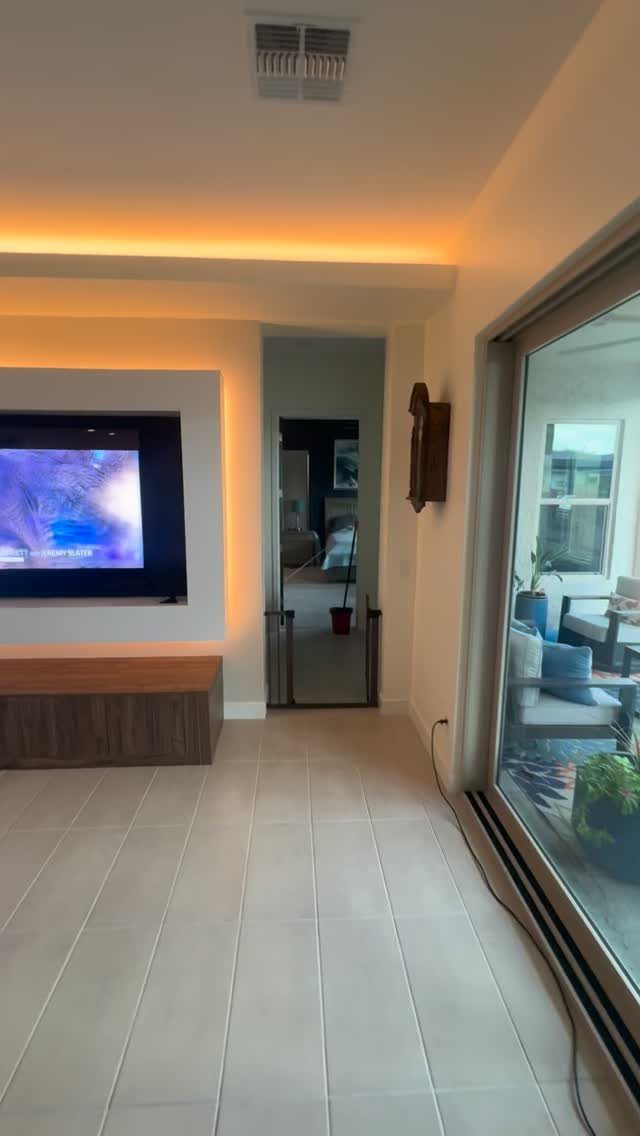
A low unit that stretches wall to wall reads as architecture instead of furniture. Nothing above the screen but wall keeps sightlines open in a room with patio doors or a hallway feeding through.
The trade is storage volume. You get a long surface and maybe drawers below, but no tall shelves for books or display.
I would choose this for a room where the TV sits secondary to windows or a view. Custom millwork gets the tight joints; a freestanding console at this length warps or gaps over time.

Introducing the only original patented Mofopole. Floor to ceiling portable tv mount that is non-permanent.

【Heavy-Duty Steel】Forget wobbly particleboard! Our media storage cabinet is built with full 0.5mm cold-rolled carbon steel, supporting up to 80lbs per shelf. It's waterproof, rust-resistant, and built for lifelong durability.

Holds Large Screen HDTV
5. Built-In Fireplace Under TV
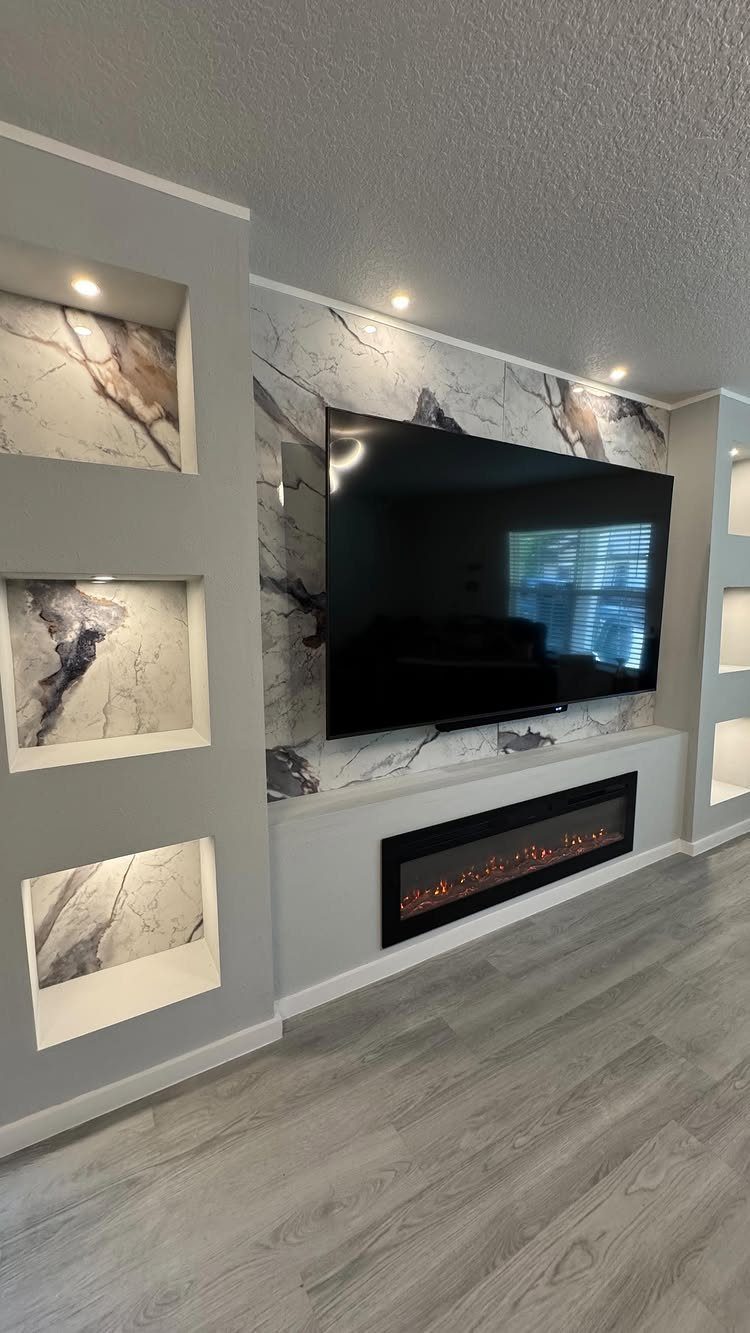
Heat below the screen solves a problem most living rooms have: the TV wall is dead space once the set is off.
An electric fireplace that runs the width of the unit, with marble backing the whole assembly, anchors the room without a gas line. The maker offers niches with three back panel choices; marble, wood, or whatever you send them.
An electric unit needs a dedicated circuit, not an extension cord behind the cabinet. Check your panel before falling for the look.
I would skip this in a room that already has a wood-burning fireplace; two flames in one space splits the focus and doubles the maintenance conversation.

Elegant 70-Inch Media Console with Built-In 40-Inch Electric Fireplace: This sophisticated TV stand seamlessly integrates a spacious 70-inch media console with a cozy 40-inch electric fireplace; designed to accommodate televisions up to 80 inches while providing ample storage with two cabinets and two open shelves

Cozy Warmth, Inviting Ambiance: Create your ideal retreat with the 18" electric fireplace, offering multiple temperature settings and 3 flame brightness levels. Easily set the perfect atmosphere for movie nights or gatherings—all with the remote or touch panel

Modern Natural Design for Any Home: Blending clean lines with authentic woodgrain textures, this Fireplace TV Stand delivers a warm, modern look that complements minimalist, contemporary, and rustic interiors. The thick, block-style silhouette in natural wood finish brings balance, simplicity, and organic elegance to any living room.
6. Vertical Wood Slat Panels
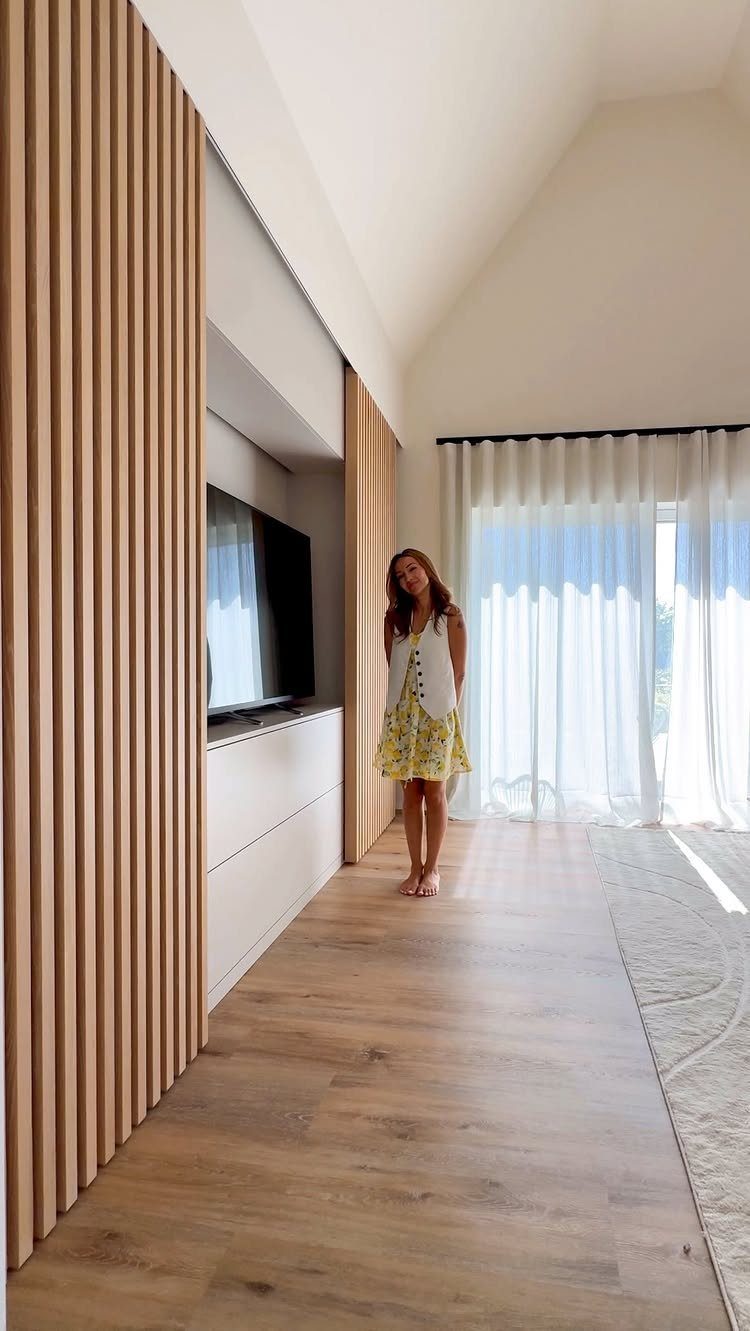
Sliding wood panels let you close off the screen without the room becoming a black rectangle. Vertical slats on tracks, light wood against white cabinets, let the closed position still feel like a design choice rather than a cover-up.
The hardware is the hidden cost. Heavy panels need serious tracks, and those tracks need blocking inside the wall during construction, not after.
I would verify panel weight against track rating before ordering; a sagging sliding door is worse than no door.
This suits someone who uses the TV rarely but wants the option, not the nightly viewer who would leave them open anyway.

Flexible Bookshelf Combo for Custom Layout: This entertainment center comes with two 4-tier side bookshelves that can be arranged freely. Place both on one side or split them on either side of the TV stand to fit your room layout and available space. The open shelf design creates a versatile display area for décor, books, and media devices, making it suitable for living rooms, bedrooms, and home offices.

【RGB Lights & Built-in Power Outlet】-Two independent light belts support 21 adjustable colors controlled by remote to build customized atmosphere for gaming, movie nights or parties. This entertainment center is equipped with a built-in multi-socket power station, it offers easy plug-and-charge access for phones, game consoles, speakers and media devices, getting rid of tangled messy cords near your TV area.

Large Multi-Layer Storage Space: This entertainment center features 10 open shelves, 2 wooden drawers and 2 large storage cabinets. It offers plenty of room for media devices, gaming consoles, books, decorative items and daily supplies, keeping your living room well-organized and clutter-free. Note: The product consists of two packages and may arrive separately
7. Shiplap Backing and Wood Countertop
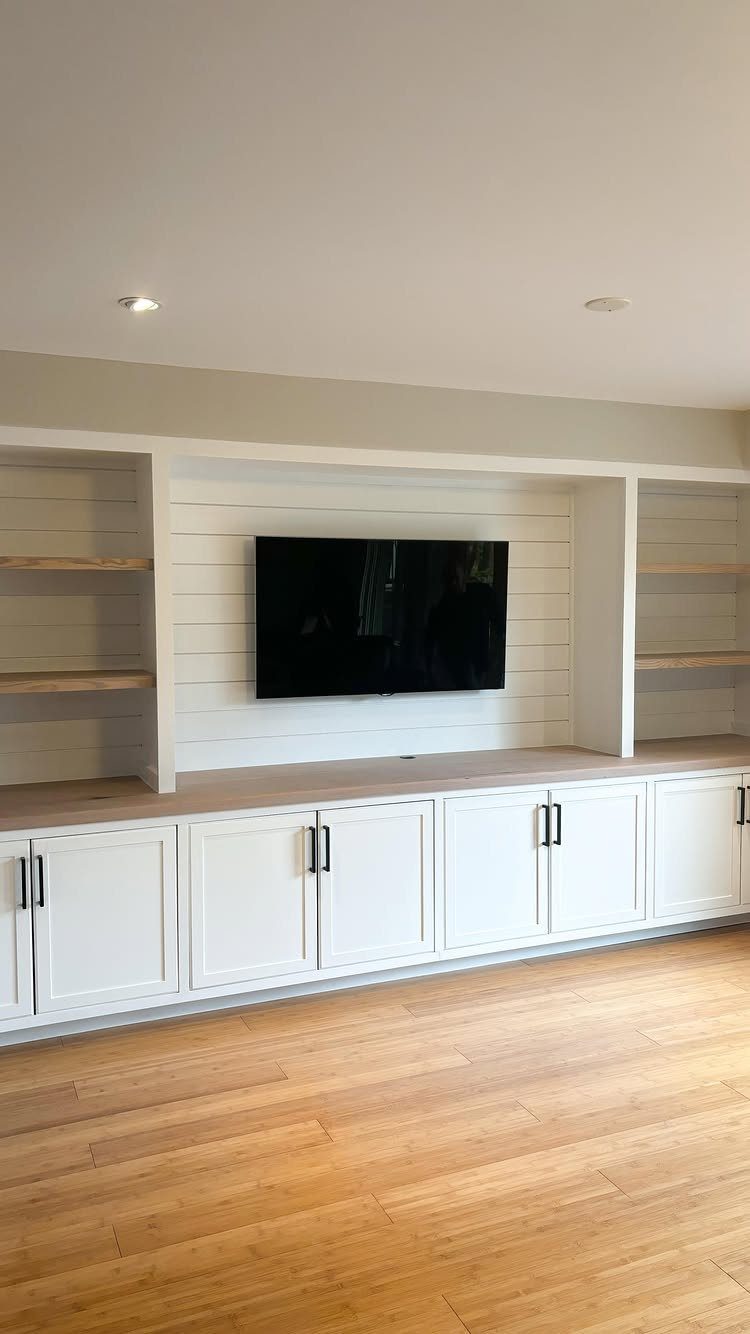
Shiplap backing and a wood countertop split the difference between farmhouse warmth and clean lines.
The horizontal boards add texture without busyness, and the natural wood surface breaks up all that white so the wall doesn’t flatten into one blank plane.
Paint-grade poplar or MDF works for the cabinets and shiplap; the countertop wants something you can actually set a drink on without leaving a ring.
Oak or maple, oiled or sealed, holds up better than pine, which dents if you look at it wrong. I routed a small chamfer on my edge to keep it from reading too thick.
The shiplap runs faster if you buy the pre-grooved boards rather than cutting your own rabbets. Leave a nickel gap for expansion, and paint before the TV goes up; touch-ups around a mounted screen are a pain.
Black hardware against white paint is the easy choice, but brass warms the whole thing if your floors run cool.
This one suits renters turned owners who want the farmhouse look without a full rustic commitment. What you trade is hidden storage; open shelves above the countertop collect dust and demand curation.
If you own more remotes than books, add a basket or two.
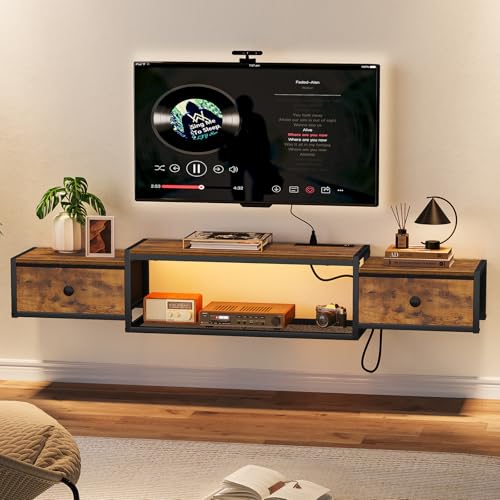
Save Floor Space: This wall-mounted floating entertainment center frees up floor space and creates a tidy living room. Measuring 63“ L x 11” W x 11" H, it accommodates TVs ranging from 32 to 75 inches. The open metal frame in the center allows for rapid ventilation and heat dissipation, making it convenient for storing electronic devices such as set-top boxes and game consoles.

Multi-Port Charging Station & Ambient Lighting: The floating TV shelf features 3 AC outlets and 2 USB ports for easy charging of your TV, gaming console, Wi-Fi router, DVD and more. Plus, an adjustable LED light offers color customization for a cozy ambiance

High-speed charging tech: Our Power Strip features a total of 10 ports, including 2 USB Type-A ports, 2 USB Type-C ports, and 6 AC power outlets. With a total output of 2.4 Amp, 5V DC, 12W power, the outlets optimize charging efficiency, up to 40% faster. When used individually, the Type C port gives 2.4 Amp 5V DC, and the Type A offers 2.4 Amp 5V DC.
8. Open Shelving Around TV
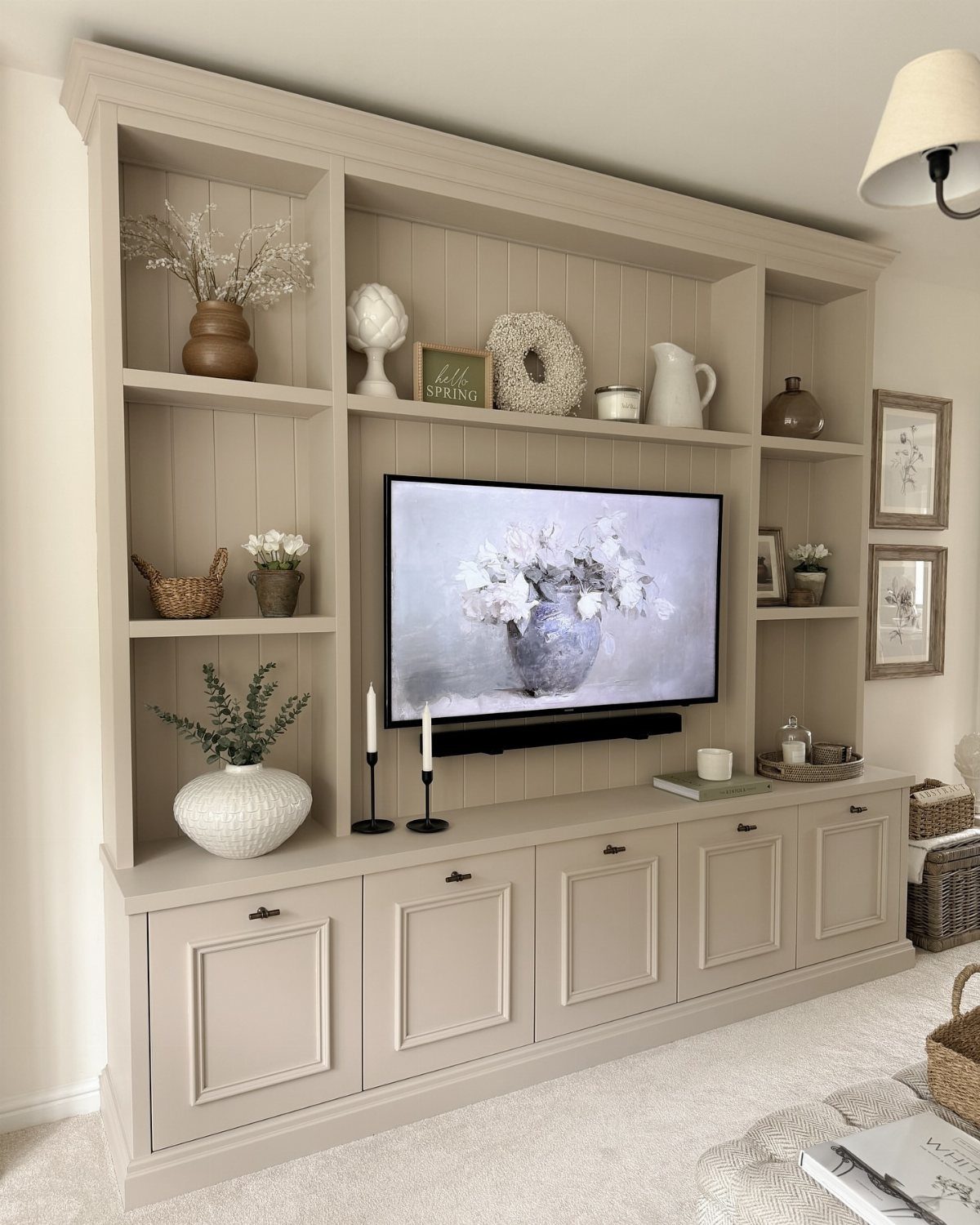
Open shelving around the TV turns the screen into one object among many instead of the room’s black hole. Floor-to-ceiling cubbies in a warm beige read softer than white and forgive dust between cleanings.
The trick is restraint. Every shelf doesn’t need something; negative space is what keeps it from looking like a thrift store display.
I group in threes, vary height, and leave at least one cubby empty per row. The TV itself can show art when it’s off, which helps it blend.
Construction is straightforward: plywood boxes faced with poplar, painted in place. The cost stays lower than cabinets because you’re skipping doors, hardware, and the fussy fitting that goes with both.
What you save in money you pay in maintenance; plan to dust weekly and edit your objects seasonally or it clutters fast.
This suits collectors, readers with good-looking spines, or anyone who’d rather rearrange objects than dust closed cabinets. If your gear hides poorly, a few woven baskets on the lower shelves swallow routers and game consoles without breaking the grid.

Bright Recessed Puck Lights - Each 2 W LED puck light provides 160 lm of focused illumination for under cabinet lighting, shelf lighting and display lighting; choose 3000K warm white, 4000K natural white or 6000K daylight white
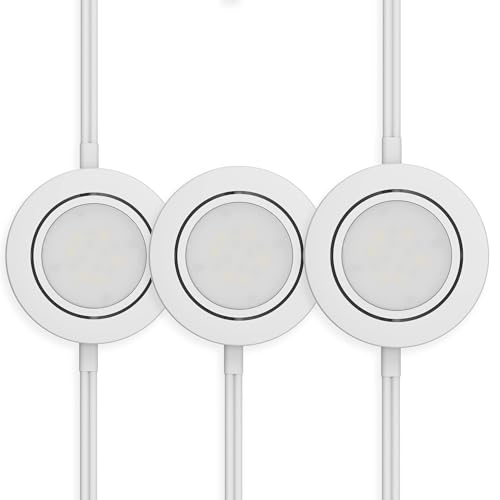
2 3/4" wide x 2 3/4"" deep x 9/10" high. Monroe puck light is wired for 120V operation, no transformer or driver needed. ETL listed ensures that it is safe to use.
Recessed Puck Lighting Kit - Compact 12V LED puck lights create a clean built-in look for cabinets, shelves and displays; each 2 W light delivers 160 lm, with 3000K warm white, 4000K natural white and 6000K daylight white options
Pros of Built-In Units
A built-in unit earns its keep by claiming space freestanding furniture cannot. Odd corners, shallow alcoves, and the dead zone above a baseboard heater all become usable once a cabinet shop measures for your specific wall.
Fixed installation has a side benefit the list does not touch: child safety. A unit anchored to studs will not tip when a toddler pulls up on the lowest shelf.
That same anchoring lets you run glass-front cabinets or open shelving higher than you would risk with anything that could rock forward.
The resale argument depends on your market. In areas where buyers expect move-in-ready finishes, a well-built unit returns more than in markets where square footage matters more than trim.
Adjustable shelves and modular guts help the unit stay relevant as screens thin and soundbars shrink, which extends the value beyond your own stay in the house.


The corner book shelf appearance is a combination of the upper and lower cabinets, the two cabinets can be disassembled and used, and can also be combined to use, with eight layers of rich storage space.
Cons of Built-In Units
Permanence cuts both ways. A built-in survives a move only if the buyer wants exactly your layout; otherwise it becomes a selling point or a negotiation chip you did not choose.
Custom work runs higher than a retail console, and the gap widens with site conditions. Out-of-plumb walls, uneven floors, and old houses with no straight lines to measure from all add hours a flat-pack kit never sees.
Professional help is not optional for anything involving wiring, gas, or structural anchoring.
Time is the hidden cost. Planning, measuring, ordering, and building can stretch across weeks, during which your living room holds a TV on a folding table.
If you are mid-project elsewhere in the house, a built-in is not a weekend impulse.

Cinematic Home Theater Experience - Featuring a panoramic 109.4-inch extra-wide surface, this entertainment center is specifically designed to accommodate massive televisions up to 100+ inches, creating a breathtaking focal point for your high-end living room or home cinema

【Modern 2-in-1 Electric Fireplace】Transform your living room or bedroom into a cozy retreat, perfect for relaxing movie nights or chilly winter evenings. Our 36" electric fireplace features vivid 3D flame effects with 12 flame modes and 5 adjustable speed and brightness settings. With dual-power heating (750W/1500W), it quickly warms rooms up to 400 sq. ft., providing both comfort and ambiance. ETL certified for safety and peace of mind

Unique Floating Design: This TV stand with fireplace features a modern, minimalist design. The 70in floating TV stand combined with a 36-inch electric fireplace, creates a versatile home entertainment hub, adding a stylish ambiance to the room
Key Considerations
Start with the room’s traffic pattern, not the wall the TV faces. A built-in that blocks a hallway sightline or crowds a patio door swing loses more than it gains.
Storage math is individual. Count your current remotes, cables, and media; add 20% for the gear you will acquire.
Open shelving demands curation discipline you may not have; hidden storage forgives a junk drawer mentality.
Budget for more than materials. A cabinet shop quote rarely includes electrician fees for new circuits, painter touch-ups, or the trim carpenter who fixes what the wall revealed when old baseboards came off.
Design aesthetic should nod to existing millwork, not fight it. If your floors run warm, cool paint choices will chafe daily.
Longevity means planning for a screen you do not own yet. Wider niches, deeper cabinets, and conduit for future wiring all add cost now that saves demolition later.
Frequently Asked Questions
How much does it cost to have a built-in entertainment center?
Custom built-in entertainment centers run higher than freestanding units because you’re paying for both materials and labor that fits your exact wall.
A hands-on build with basic materials and your own labor usually lands between a few hundred and a thousand dollars. Once you add custom millwork, integrated lighting, fireplace inserts, or floor-to-ceiling scale, the price climbs well past that.
The permanent install and weeks-long timeline are the trade for something that doesn’t gap or warp like a long console.
Are built-ins a good idea?
Built-ins suit you if you want storage that reads as architecture and don’t mind giving up the wall permanently. They’re harder to move or change once installed, and the planning can stretch across weeks.